Digital Organization and Productivity for Running Traffic
See how to build an organized digital workspace with a CRM, dedicated email, and a focus routine to boost productivity and sustain a traffic operation.

Why digital organization comes before copy and traffic
If you want to make a living from paid traffic, the first thing you need to sort out isn't copy or campaign structure. It's digital organization. Without a space where you sit down, log in, and get into focus, everything else falls apart. Most media buyers get stuck right here and don't even notice: they think the problem is the offer, when the real problem is that their operation lives scattered across ten tabs and three notifications a minute.
We're in the attention era. Way too many people are trying to grab yours all day long. And every time you glance over to check a message, an email, a notification, your productivity evaporates. This isn't being precious. It's a real operating cost.
What a digital workspace that puts you in flow looks like
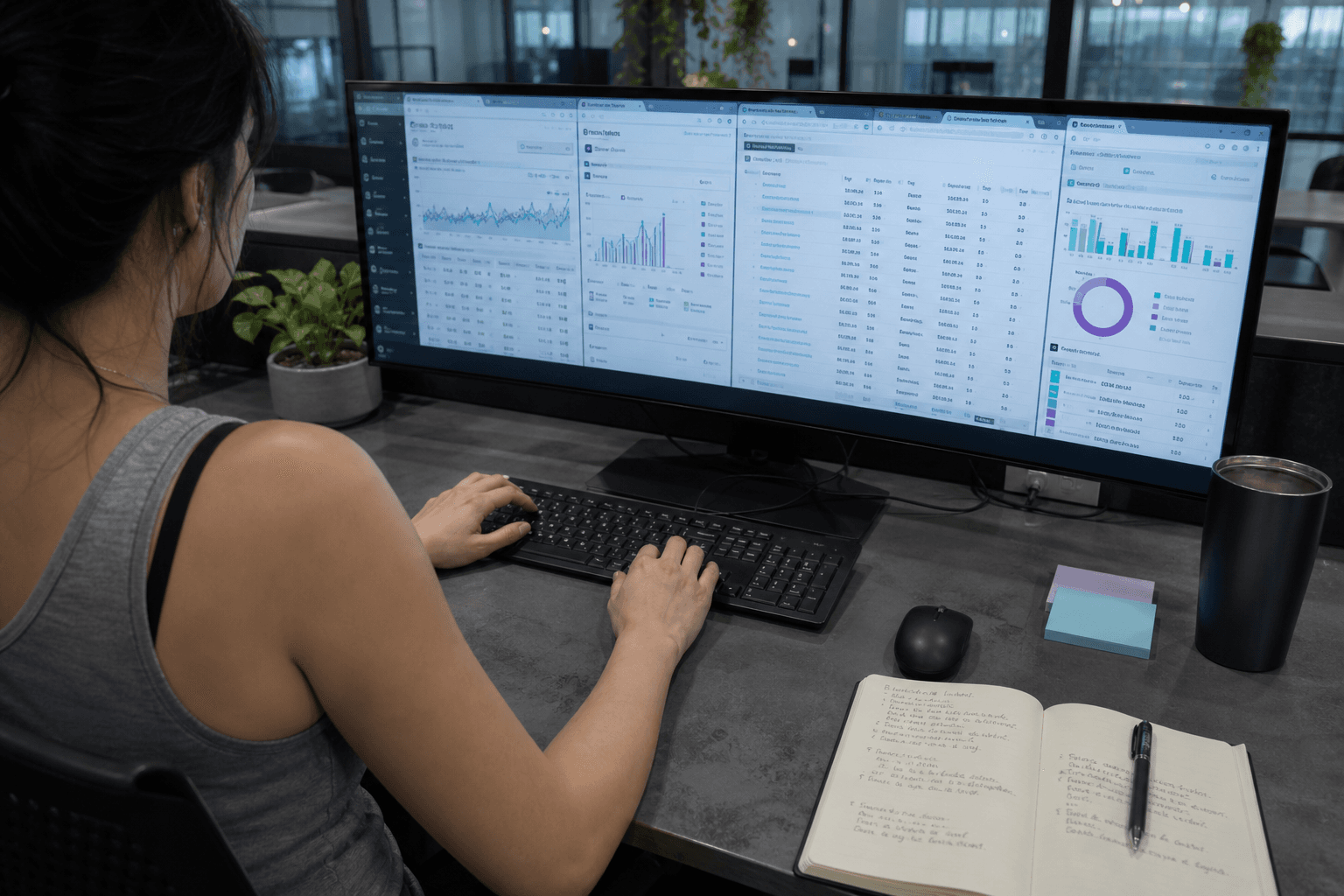
Your digital workspace is where you operate: the tools you open, the tabs you pin, the accounts you separate by function. When that space is a mess, you burn energy just deciding where to start. When it's clean, you sit down and produce.
The rule is simple: each tool has one function and only one. You log into it and you don't see what's going on around you. The world can be ending outside. Inside that screen, you're in the operation.
Anyone who runs traffic knows the difference between opening your computer to work and opening your computer and spending 40 minutes replying to things that didn't need to be answered right now. That second situation is what kills most people.
A CRM and email dedicated to the operation
Here's the practical part. Use a CRM just for the operation. The moment you log in, the world disappears. You don't see the family group chat, you don't see store promos, you don't see app alerts. You see your operation and nothing else.
Same goes for email. Have a dedicated email just for that function. Why? Because that way you don't open your inbox to check a message from a supplier and walk out of it thinking about the HOA bill that just landed.
The math is simple: if today's commitment is the digital work, anything that isn't digital can't show up in your digital workspace. Bills have a set day to be paid. You pay at the scheduled time and move on. Don't let a random email hijack your attention in the middle of building a campaign.
When you mix everything into one account, your head turns into an auction. Every notification bids for your focus. And fragmented focus won't scale any operation.
How to manage your attention and cut distraction
Productivity in traffic isn't about working more hours. It's about working the right hours without interruption. A two-hour block in flow beats a whole day chopped into pieces.
Cut what pulls your attention before you start:
- Phone message notifications, off during your operation block
- Social media tab closed, not minimized
- Personal email outside your work browser
The problem isn't that you're lazy. The problem is that the entire environment was designed to distract you. You have to design yours to fight back.
A big chunk of operational friction disappears when you automate the repetitive stuff. Every time you do a repeating task by hand (uploading the same variations, redoing the same ad set setup, replicating a campaign across accounts), you open a window for errors and for drifting off. This is exactly the kind of work where a bulk upload flow takes the grunt work out of the way and lets you focus on the decision, not the typing.
Routine, the right hours, and physical activity
Some people think working from home means sitting on the couch with a kid running around on one side, another making noise, the TV on. It's not the same thing. It doesn't work. Period.
A traffic operation needs set hours. Time to start, time to stop. Without that, work bleeds into the small hours and the small hours bleed into the next day, and you're never fully working or fully resting.
And here's the part nobody wants to hear: physical activity. Anyone who spends all day inside the Ads Manager, staring at numbers, making budget calls, without moving their body, cracks up. The brain needs to discharge. Twenty minutes of walking does more for your ROAS than the twentieth refresh on the results screen.
These are small details. But it's the pile-up of small details that keeps people from getting results, even when they know copy and traffic inside out.
The operational detail that makes people quit
Here's the classic scenario. The guy has mastered copy. He knows the auction, the structure, the offer. And then an operational problem takes it all down: a page that crashes at peak traffic, a setup that goes wrong at volume, an account that locks up mid-scale. He loses his footing and quits.
He didn't quit for lack of knowledge. He quit because his operation had no structure to absorb the technical problem.
This is where it gets serious. The more manual your operation is, the more failure points it has. Uploading 80 variations by hand across five accounts is an invitation to naming errors, swapped targeting, and duplicated ad sets. Automating that part with standardized naming across accounts isn't a luxury, it's what keeps a dumb technical detail from knocking you offline on a scaling day.
Digital organization and automation go together. One clears your head, the other clears your execution. With both running, the operational problem stops being the reason you quit and becomes just one more thing you fix and move past.
Takeaways
- Set up a CRM and an email just for the operation: when you log in, the outside world doesn't exist
- Set hours to start and stop, and move your body every day so you don't crack up
- Cut notifications before your focus block: tab closed, phone silent, personal email out of the work browser
- Automate the repetitive stuff to cut the operational failure points that make good people quit
Frequently asked questions
Do I need an expensive CRM to organize my traffic operation?
No. The point isn't the price of the tool, it's the separation of function. What matters is having a space where you log in and only see the operation, without the rest of the world fighting for your attention.
Why separate the operation email from the personal email?
Because every time you open an inbox that mixes everything, a personal matter steals your focus in the middle of a task. A dedicated operation email keeps your head only on the digital work during your working hours.
Does working from home hurt productivity in traffic?
It does if you don't set up a defined space and defined hours. Sitting in the middle of household chaos doesn't work. With a separate space, set hours, and distraction cut out, home becomes a productive environment.
How do I keep a technical problem from making me quit the operation?
By reducing the failure points. The more manual and repetitive the tasks, the more chance of error at volume. Automating upload, structure, and campaign standardization lowers the technical friction that usually takes down people who already know copy and traffic.